A hundred-year-old silk damask is not a fabric to be replaced. It is a document: it speaks of a taste, a craft, often a family. Textile restoration starts from here, from the idea that you conserve wherever you can, and remake it as it was wherever you cannot.
It is the most delicate work we do in our workshop, and the one that best explains why this craft cannot be improvised.
First of all, look
Every intervention begins with an examination of the fabric:
- the fibre and the weave: silk, silk and linen, damask, lampas, brocade;
- its condition: tears, worn patches, broken threads, areas weakened by light;
- the colours: how faded they are, and whether evenly or in patches;
- its history: earlier repairs, seams, linings added later.
The approach depends on this examination. And one rule applies: no “test” washing at home. Antique silks and dyes can react unpredictably to water and detergents.
Three possible approaches
Conserve. When the fabric is weakened but intact, it is consolidated: secured to a suitable support with stitching that holds it together without altering it. This is the most respectful approach.
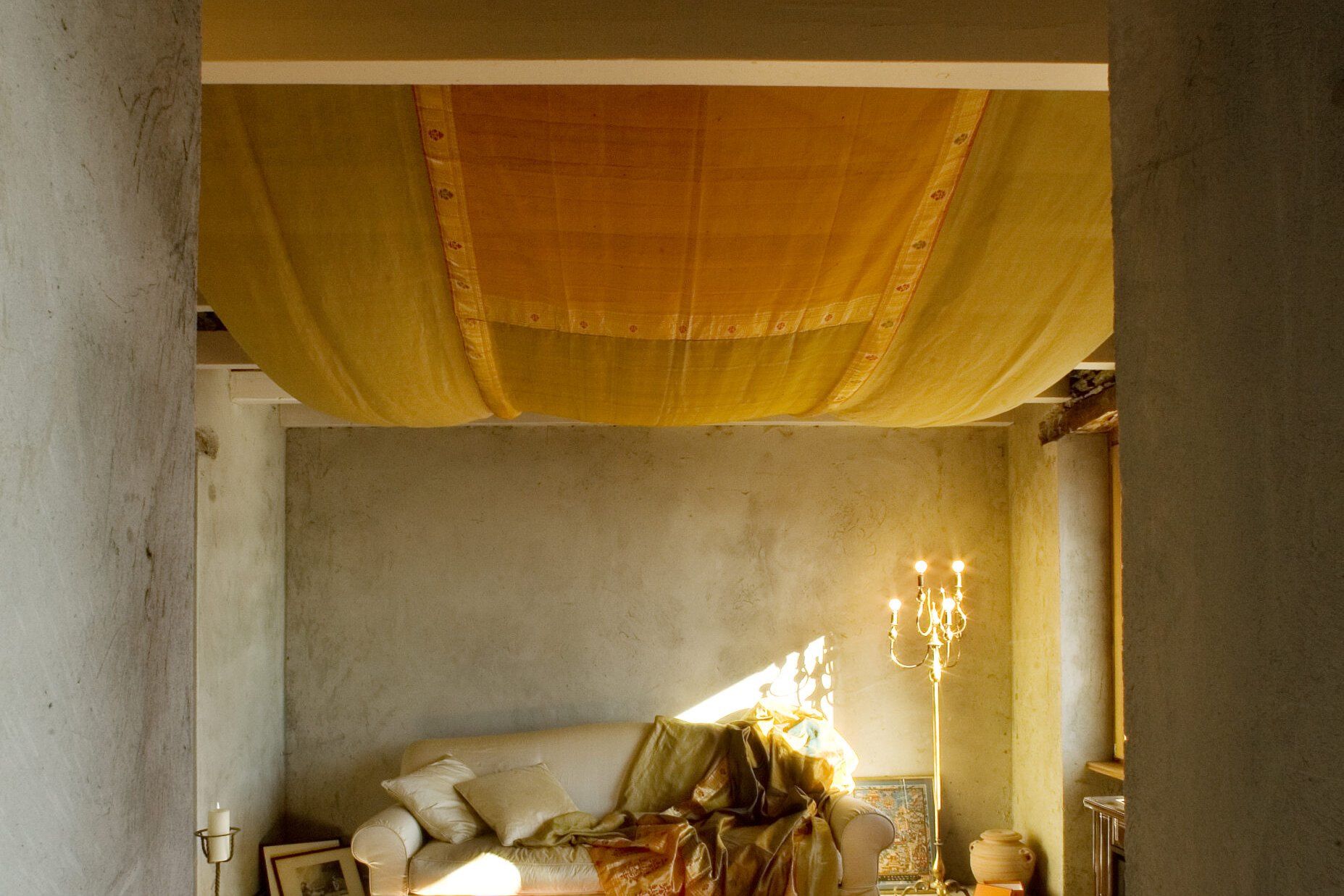
Stretch. For fabric wall coverings, re-stretching restores the fabric’s surface, removing creases and sagging, with fixings that can be removed in future.
Remake as it was. When a section cannot be saved, it is replaced with a fabric as faithful as possible to the original. Some textile houses have historic archives and can reproduce period designs and colours: Rubelli, in Venice, is one of them.
Often the answer is a combination: the main piece is conserved, and the good sections of what cannot be saved are reused for cushions, panels or borders.
Period upholstery
Antique sofas, armchairs and daybeds almost always have traditional upholstery: horsehair, hand-tied springs, hessian. In restoration these are remade using the same techniques, to keep the original shape and seat. The fabric, whether antique or new, is fitted by hand.
After restoration
A restored textile lives a long life if you protect it from three things:
- direct light, silk’s greatest enemy: it is best to screen the windows with voiles or light-filtering curtains;
- damp and sudden changes in temperature, which weaken the fibres;
- dust, to be removed gently, without rubbing.
An example
In our silk damask restoration project we worked on archive fabrics with re-stretching and conservation. If you have a piece that is dear to you, you can send us a few photographs: we will tell you what can be done, and how we would approach it. You will find the full service on our upholstery and restoration page.